I remember walking into a school kitchen three years ago during the mid-morning rush; the air was thick with the smell of toasted bread and the frantic clatter of stainless steel. I saw a cook reach for a tray of allergen-free muffins, only to realize her apron was covered in flour from the standard batch being prepped two stations away. It wasn’t a lack of equipment that failed that day, but a misunderstanding of how personal protective equipment is used when the pressure is on. Most training manuals treat PPE like a magic shield, but in a real, high-speed kitchen, it’s actually a tool for separation that people often ignore the moment they feel “too busy” to bother.
I’m not here to lecture you on the theoretical benefits of a clean apron or a fresh pair of gloves. My goal is to show you what actually works when you have forty minutes to prep three hundred lunches and a team that is already stretched thin. I will give you the practical, unsentimental truth about implementing PPE in a way that actually reduces risk without turning your kitchen into a slow-motion obstacle course.
Table of Contents
Prioritizing Workplace Safety Equipment Types That Actually Last
When you’re staring down a service rush for five hundred hungry students, the last thing you need is a pair of cheap, flimsy gloves that split the second they touch a knife, or an apron that soaks through in minutes. I’ve seen too many kitchens try to save a few pennies on low-grade gear, only to find that the equipment becomes a hazard itself. If you want to maintain actual occupational safety standards, you have to stop treating PPE like a disposable afterthought and start viewing it as a tool, just like a chef’s knife or a heavy-duty mixer.
Focus your budget on the items that take the most abuse. In a school kitchen, that usually means high-quality, heat-resistant gloves for oven work and heavy-duty aprons that can withstand industrial laundering. It isn’t about buying every gadget on the market; it’s about choosing specific workplace safety equipment types that can survive a twelve-hour shift and a high-temperature dishwasher. If the gear is uncomfortable or breaks easily, your staff won’t use it—and once they stop using it, your risk profile skyrockets.
Mastering Proper Donning and Doffing Procedures Amidst the Rush
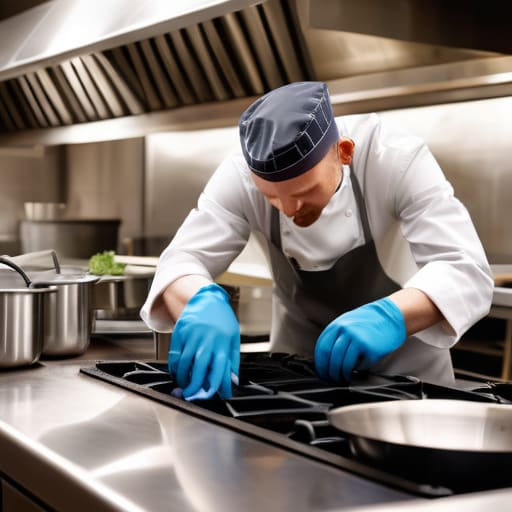
I’ve seen it a hundred times: the lunch service rush hits, the ticket machine is screaming, and suddenly, the apron or the gloves are treated like an afterthought. Someone pulls a fresh pair of gloves on while still leaning over a dirty prep station, or worse, they adjust their hair and then grab a knife without a second thought. This is where proper donning and doffing procedures fail in the real world. It isn’t about being pedantic; it’s about the fact that if you don’t control how you put gear on and—more importantly—how you take it off, you are just moving bacteria from the bin to the buffet.
In a high-pressure school kitchen, you can’t expect staff to follow a clinical manual, but you can demand a sequence. I always tell my teams: treat your PPE like a one-way street. Once you’ve transitioned from raw prep to plating, your gloves and aprons shouldn’t just be tossed aside; they need to be removed in a way that doesn’t contaminate your hands or your uniform. If you aren’t disciplined about this transition, you aren’t actually practicing hazard prevention techniques; you’re just performing a pantomime of safety.
Five Real-World Rules for When the Rush Hits
- Stop treating gloves like a magic wand. They aren’t a substitute for handwashing; they’re an extra layer. If your team is changing tasks but skipping the sink because “the gloves are still clean,” you’re just spreading cross-contamination in a more expensive way.
- If the apron is soaked or caked in sauce, it’s no longer a barrier—it’s a reservoir. I’ve seen too many staff members working through a lunch rush in the same apron they wore during prep. If it’s dirty, swap it. It takes thirty seconds; a food poisoning outbreak takes much longer to resolve.
- Watch the “double-dipping” with PPE. I often see staff grab a clean pair of gloves, use them to handle an allergen, and then use those same gloved hands to adjust their hairnets or wipe their brows. That’s how you turn a piece of protective gear into a vector for contamination.
- Don’t buy the cheap stuff just to save the budget if it doesn’t work. If your aprons are tearing or your gloves are ripping during heavy prep, your team will stop using them because they’re frustrated. Practicality beats a line item on a spreadsheet every single time.
- Make the “why” part of the training. Don’t just tell a junior chef to wear a hairnet because it’s the rule; tell them it’s because one stray hair in a school meal is a nightmare that stays with you long after the shift ends. When they understand the risk, the habit actually sticks.
The Bottom Line: Making PPE Work When You're Under Pressure
Stop treating PPE like a checkbox; if the equipment is uncomfortable or gets in the way of a fast-paced service, your team will find ways to bypass it, and that’s exactly when the risk spikes.
Focus your training on the ‘why’—a staff member who understands that a clean apron isn’t just about looking professional, but about preventing cross-contamination between raw and ready-to-eat foods, is much more likely to maintain the habit.
Build your PPE routine into the existing workflow rather than treating it as an extra task; if it’s not easy to access and easy to use during a rush, it won’t be used properly when you need it most.
Frequently Asked Questions
If we’re short-staffed and the lunch rush is hitting, is it actually safer to skip the apron change between tasks, or is that just asking for a cross-contamination incident?
Look, I’ve seen the chaos of a lunch rush, and I know the temptation to keep the same apron on while moving from raw prep to plating up is massive. But skipping that change is exactly how a “minor oversight” becomes a medical emergency. If you’re short-staffed, you don’t have time for a crisis. If you can’t change the apron, change the task order. Don’t gamble with cross-contamination just to save thirty seconds.
How do I stop my team from treating disposable gloves like a "get out of jail free" card for poor hand hygiene?
The biggest mistake I see is treating gloves like a barrier between the cook and the dirt. They aren’t. If your team is “washing” hands by just swapping gloves, you’re asking for a cross-contamination disaster. I tell my kitchens this: gloves are an extension of your skin, not a substitute for soap. Make it clear—gloves are for specific tasks, not for laziness. If they aren’t washing their hands every single time they change them, the gloves are useless.
At what point does a piece of kit—like a worn-out apron or a cracked plastic shield—stop being "fine for today" and start becoming a genuine liability?
It stops being “fine” the moment it compromises the barrier it’s meant to provide. A cracked shield isn’t just a nuisance; it’s a physical gap where a splash can bypass protection. A frayed apron isn’t just “well-loved”; it’s a harbor for bacteria and a snag hazard. If you’re looking at a piece of kit and making an excuse for it, you’ve already crossed the line from “making do” to “taking a risk.”