I once walked into a school kitchen during a Tuesday lunch rush where the chaos was palpable; the steam was thick, the clatter of trays was deafening, and the head cook was sweating through her apron trying to plate up three hundred portions of pasta. When I asked to see their serving protocols, she just pointed at a pile of mismatched ladles and sighed. Most people will try to sell you a complete guide to portion sizes that involves high-tech digital scales, expensive software, or some ridiculous “gram-perfect” obsession that works in a laboratory but fails the second a student starts complaining or a staff member calls in sick. In a real, high-pressure kitchen, precision isn’t about perfection; it’s about control.
I’m not here to give you a textbook lecture on nutritional mathematics or tell you to buy more equipment. Instead, I’m going to give you the practical, unvarnished truth about how to manage portions when you’re short-staffed and over budget. We are going to focus on the tools you actually have—like consistent scoops and visual markers—to ensure your costs stay predictable and your plates stay consistent. This is about what you can actually sustain when the lunch bell rings.
Table of Contents
Visual Portion Size Cues the Practicality of Sight Over Scales
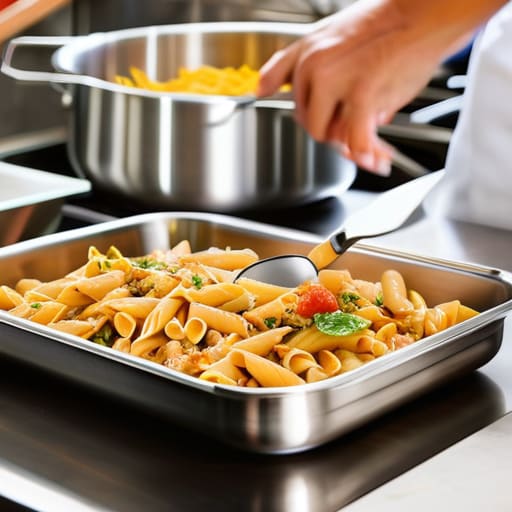
In a busy school kitchen, I know the reality: nobody has time to weigh out 85 grams of pasta for every single child while the lunch bell is ringing. If I walked into a kitchen and saw staff huddled around digital scales for every plate, I’d tell them they’re wasting precious minutes they don’t have. That’s why we need to rely on visual portion size cues that actually work in the heat of service.
Instead of precision weighing, I teach staff to use the hand measurement portion method as a quick, reliable baseline. A palm-sized piece of protein or a fist-sized serving of veg isn’t just a shortcut; it’s a way to maintain consistency when the pressure is on. It’s about teaching the team to “see” the portion before it hits the tray. If you can train your staff to recognize these physical benchmarks, you aren’t just making service faster—you are preventing food waste through planning by ensuring you don’t over-scoop the expensive stuff. It’s about being smart with what you’ve got, rather than fighting a losing battle against the clock.
The Hand Measurement Portion Method for High Pressure Services
Now, let’s be honest: if I walk into a kitchen during the lunch rush and tell a cook to grab a digital scale to weigh out every serving of mash, I’ll be laughed out of the building. In a high-pressure service, especially when you’re feeding hundreds of kids, scales are often the first thing to go unused because they simply aren’t practical. This is where the hand measurement portion method becomes your best friend. It isn’t some vague nutritional theory; it’s a way to maintain some semblance of control when the chaos hits.
Using your hand as a living, breathing reference tool allows for quick, reliable checks without slowing down the line. A palm-sized piece of protein, a fist-sized portion of veg, and a thumb-sized serving of fats—it sounds simple, almost too simple, but it provides a baseline that keeps you within reasonable nutritional adequacy standards. It’s about giving your staff a mental model they can actually use while they’re juggling three things at once. You aren’t aiming for laboratory precision here; you’re aiming for consistency that prevents both waste and error.
Five Ways to Stop Portion Creep Without Slowing Down the Service
- Standardise your scoops and ladles. If you’re letting staff “eyeball” a serving of mash or pasta, you aren’t running a kitchen; you’re running a guessing game. Buy the specific sized ladles for your specific recipes and make it a non-negotiable that they use them. It’s faster than a scale and keeps your costs from bleeding out.
- Use the “buffer” rule for high-risk allergens. If you are portioning something that contains a major allergen, don’t just eyeball the amount—measure it. When a child has an anaphylactic reaction, “it looked like a small amount” is a sentence that will haunt your career and likely end up in a courtroom.
- Plate for the eye, not just the stomach. In a school setting, a plate that looks half-empty feels like a failure to the kids, even if the nutrition is spot on. Use smaller plates if you have to; it makes the portion look generous and prevents the “scarcity” mindset that leads to staff over-serving to be “kind.”
- Watch the “scrapings.” I’ve seen it a hundred times: a staff member finishes a container, thinks there’s a bit left, and scrapes a massive, unmeasured glob onto the last ten plates. If the container is empty, it’s empty. Don’t let the end of the service become a free-for-all that ruins your margins.
- Audit the waste, not just the plate. If you want to know if your portion sizes are actually working, don’t just look at what’s being served—look at what’s being scraped into the bin. If you’re seeing mountains of untouched veg coming back, your portions are too big, you’re wasting money, and you’re teaching kids to throw food away.
The Bottom Line for Your Service
Stop obsessing over digital scales during a lunch rush; use visual cues and hand measurements to maintain consistency when the pressure is on.
Precision isn’t just about food costs—if your portions are wildly inconsistent, you risk under-serving vulnerable groups or failing to meet specific nutritional requirements.
Pick a method you can actually sustain with your current staffing levels, because a “perfect” system that nobody follows is just a waste of your time.
Frequently Asked Questions
If we move away from scales to save time, how do I actually prove to a manager or an auditor that my staff are being consistent?
You don’t prove consistency with a pile of weighing slips; you prove it with a visual standard. If you’re ditching the scales, you need “Gold Standard” photos. Print them, laminate them, and stick them right at eye level on the pass. Show exactly what a standard portion of pasta or protein looks like in the specific bowl you use. When an auditor asks, you don’t show them math—you show them the visual benchmark your team follows every single shift.
How do I balance these portion guidelines with a kitchen that's running short-staffed and just needs to get the food out the door?
Look, I’ve been in those kitchens where the lunch bell is ringing and you’re two bodies down. You aren’t going to weigh every potato. If you try to be perfect when you’re drowning, you’ll just end up making mistakes elsewhere—like forgetting the allergen check. Stick to the visual cues we talked about. Use the scoops, use the marked ladles, and trust the “eye.” Consistency isn’t about being surgical; it’s about being predictable.
When dealing with specific dietary requirements or allergen-free meals, does the portioning method need to change to ensure safety?
The method doesn’t change, but the discipline has to. Whether you’re using a scoop or a visual cue, the portion size itself isn’t the safety risk—it’s the cross-contamination during the process. If you’re portioning an allergen-free meal, that specific portion needs its own dedicated, cleaned equipment and a separate staging area. Don’t let the rush of a busy service tempt you to use the same tongs you just used for the pasta. Consistency in size is good for the budget; consistency in separation is what keeps kids out of hospital.