
I’ve sat in enough cramped, humid school kitchens to know that the moment I pull out a folder titled “Chemical Safety Management,” the atmosphere in the room shifts from productive to defensive. Most training manuals make it sound like you need a PhD in chemistry to understand how COSHH assessments are done, suggesting you need a mountain of paperwork that sits gathering grease in a corner. But let’s be honest: you don’t need a twenty-page dissertation for every single spray bottle under the sink. What you actually need is to know exactly which degreaser is going to burn your skin if it splashes during a frantic Friday lunch rush when you’re down to two staff members and a pile of trays.
In this guide, I’m stripping away the legalistic fluff and the box-ticking exercises that change nothing. I am going to show you how to build a system that actually works for a busy kitchen—one that focuses on the practical controls that keep your team safe without drowning you in admin. I’ll tell you what you can realistically sustain when the timer is ticking, and we will focus on the small, boring details that actually prevent incidents.
Table of Contents
Identifying Hazardous Ingredients and Real World Risks
When I walk into a school kitchen, I’m not looking for a pristine cupboard; I’m looking for the stuff that can actually hurt someone. Identifying hazardous ingredients isn’t just about the heavy-duty oven cleaner; it’s about recognizing that even a concentrated dishwasher tablet or a caustic degreaser is a threat if it’s being handled by a tired Year 11 catering student at 3:00 PM. You need to look at every single bottle, spray, and powder and ask: what happens if this gets in someone’s eyes or on their skin?
Don’t get bogged down in the theory of COSHH regulation compliance, but do get serious about your safety data sheets usage. These aren’t just pieces of paper to be shoved into a dusty binder; they are your instruction manual for when things go wrong. If a staff member splashes a concentrated sanitizer on themselves, the SDS tells you whether to rinse for five minutes or call an ambulance immediately. Once you know what you’re dealing with, you can decide on your control measures for chemicals—whether that’s switching to a diluted system or simply ensuring everyone is wearing the right gloves.
Mastering Safety Data Sheets Usage for Busy Teams
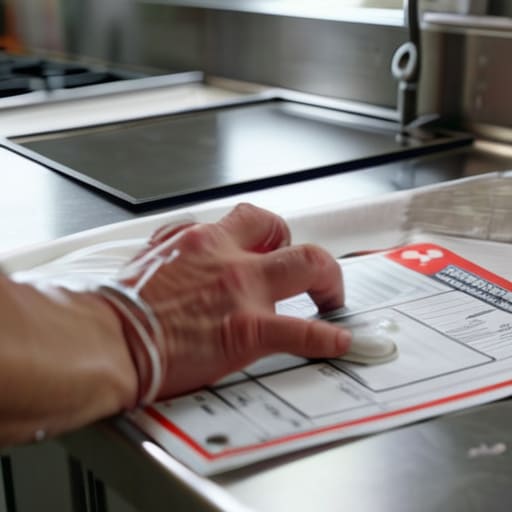
Now, let’s talk about Safety Data Sheets (SDS). If you’ve ever seen a thick, dust-gathering binder sitting on a high shelf in a school kitchen, you know exactly what I mean. Most of the time, those sheets are treated like a chore to be filed away rather than a tool to be used. But when you are mid-service and someone accidentally splashes a concentrated descaler into their eyes, that binder is the only thing that matters. Effective safety data sheets usage isn’t about reading every single word of technical jargon; it’s about knowing exactly where to look for the emergency instructions and the specific first aid measures required for that particular chemical.
I don’t expect your team to be chemists, but they do need to understand the difference between a mild detergent and a caustic oven cleaner. When you are developing your control measures for chemicals, use the SDS to dictate your practical rules: which gloves are actually thick enough to stop a soak-through, and whether a specific spray needs to be used in a well-ventilated area. If the sheet says a substance is a respiratory irritant, don’t just shrug it off—make sure that vent is actually switched on.
Five Ways to Make COSHH Work Without Losing Your Mind
- Stop treating every single bottle like a high-level chemical threat. You don’t need a separate, complex assessment for a standard dish soap, but you absolutely do need one for that industrial-strength oven cleaner that can cause permanent lung damage if it’s sprayed in a poorly ventilated corner during a mid-service rush.
- Get out of the office and into the kitchen to do the actual assessing. A piece of paper might say “use gloves,” but if you’re watching a prep cook try to squeeze into oversized, flimsy latex gloves just to wipe down a stainless steel bench, you know your current control measure is a fantasy.
- Simplify your language so it actually sticks. If your COSHH folder is written in “legal-speak” that requires a degree to decipher, your staff won’t read it—they’ll just bypass it. Tell them clearly: “This one burns skin, this one shouldn’t be mixed with bleach, and this one needs a mask if you’re using it in the walk-in.”
- Focus on the “What Ifs” rather than just the “What Is.” A good assessment isn’t just a list of ingredients; it’s a plan for when things go wrong. What happens if a drum of degreaser tips over during a frantic Friday clean? If your team doesn’t know where the spill kit or the eye-wash station is, your assessment has failed.
- Make sure your training isn’t a “once a year” box-ticking exercise. I’ve seen too many kitchens with perfect paperwork and staff who had no idea what a Safety Data Sheet actually looked like. Real safety happens in the thirty-second demonstration you do when a new hire picks up a chemical for the first time.
Making COSHH Work When You’re Short-Staffed
Stop chasing paperwork for the sake of a folder; focus your assessments on the high-risk chemicals—like heavy-duty degreasers or concentrated sanitizers—that actually pose a threat during a frantic service.
Your Safety Data Sheets shouldn’t be buried in a binder in the office; they need to be accessible and understood by the person actually holding the spray bottle, not just the manager.
A COSHH assessment is useless if it doesn’t account for how people actually work, so ensure your controls match the reality of a busy kitchen rather than an idealized version of it.
Frequently Asked Questions
I’ve already got a folder full of Safety Data Sheets; do I actually need to write something separate for every single chemical we use?
Look, I know that folder feels like a paperweight, and the last thing you want is more paperwork. But no, a Safety Data Sheet isn’t a COSHH assessment. The SDS tells you what the chemical is; the assessment tells your team how to use it without ending up in A&E. You don’t need a novel for every spray, but you do need a simple, one-page way to show your staff exactly how to handle that specific degreaser safely when things get frantic.
How do I handle the "grey areas," like when we're using a standard degreaser but mixing it with something else or using it in a way the manufacturer didn't intend?
This is where things get dangerous, and frankly, it’s where I see the most preventable injuries. Here is the hard truth: there are no “grey areas” in chemistry, only bad decisions. If you mix a degreaser with an acid-based cleaner to “boost” it, you aren’t being efficient; you’re potentially creating toxic chlorine gas. If the manufacturer says use it diluted, do not use it neat. If you deviate from the label, your COSHH assessment is officially void.
If I’m running a skeleton crew during a lunch rush, what is the absolute bare minimum I need to have in place to ensure my staff aren't accidentally hurting themselves?
If you’re down to a skeleton crew, forget the thick binders. You need three things: a single, clearly labelled folder containing the Safety Data Sheets for your most aggressive chemicals, a “no-go” list of what never to mix (like bleach and anything acidic), and a station where everyone knows exactly where the eye-wash is. If they can’t find the PPE or the SDS in ten seconds during a rush, your system has already failed.