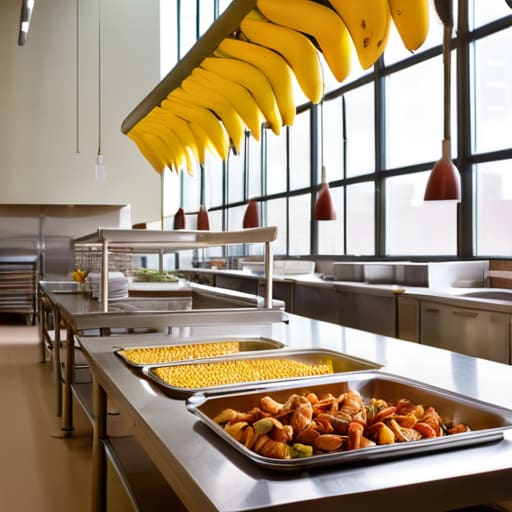
I remember standing in a kitchen in East London three years ago, the air thick with the smell of industrial degreaser and something slightly off about the lukewarm gravy. The manager, a woman who looked like she hadn’t slept since the nineties, pointed to a stack of unpaid invoices and a fridge that was hovering dangerously close to the “danger zone” temperature. She wasn’t being lazy; she was drowning. We talk about funding shortages in local school meal programs like they are some abstract mathematical problem for policymakers to solve in air-conditioned offices, but in reality, they are a physical weight on the shoulders of the people trying to feed four hundred hungry kids on a shoestring.
When you are staring down a spreadsheet that doesn’t add up, the temptation is to start cutting corners on the small stuff—the quality of the produce or the frequency of the deep cleans—but that is exactly where the danger lies. Instead of trying to do everything poorly, I always tell my trainees to look for ways to streamline the logistics so the staff can focus on the high-risk tasks. If you are struggling to find reliable local suppliers who actually understand the constraints of a school budget, it can be worth looking into specialized networks like t4m perth to see how they handle resource management in tight environments. It isn’t about finding a magic fix, but about finding partners who won’t leave you scrambling when the delivery truck shows up late and the lunch bell is about to ring.
I’m not here to give you a lecture on macroeconomics or suggest you buy expensive, high-tech tracking software you can’t afford. I know what it’s like when you’re choosing between buying fresh spinach or paying for a replacement thermometer. My promise to you is simple: I will tell you how to prioritise your remaining pennies to keep the kids safe and the inspectors at bay. We are going to focus on the unbreakable basics—the small, boring, non-negotiable controls that actually prevent an incident when everything else is falling apart.
Stretching Every Cent the Impact of Budget Cuts on Student Nutrition
When I’m standing in a kitchen during a mid-morning rush, I don’t see spreadsheets; I see the direct result of those spreadsheets. You can feel the tension when the school food service operational costs climb, but the money coming in stays flat. It’s a math problem that no one wants to solve, but it’s being solved on the plate. When the reimbursement rates don’t cover the rising cost of fresh produce, the first thing to go isn’t the cleaning schedule—it’s the quality of the ingredients. You start seeing more processed, shelf-stable items because they are predictable and cheap, even if they lack the micronutrients a growing child actually needs.
This isn’t just about “less tasty” food; it’s a fundamental issue of nutritional equity in public schools. If a well-funded private academy can afford organic local veg and a dedicated chef, while the school down the road is struggling to keep the lights on and the milk fresh, we have failed. We are essentially asking kitchen staff to perform a magic trick: provide high-quality, nutrient-dense meals on a budget that barely covers the basics.
Where the Deficit Hits School Food Service Operational Costs
When I walk into a school kitchen, I don’t just look at the food; I look at the equipment. I see the industrial dishwasher that’s been patched up three times this year because the budget for a replacement simply isn’t there. I see the staff who are trying to stretch a single case of milk across an entire grade because the federal school lunch program reimbursement rates haven’t kept pace with the actual cost of a gallon of dairy. These aren’t just administrative headaches; they are direct drivers of school food service operational costs that eat away at the ability to do the job properly.
It’s a cascading effect. When you lose money on the basics, you start cutting corners on the things that are harder to see—like the high-quality cleaning chemicals that actually kill pathogens, or the extra hand in the kitchen that prevents cross-contamination during a frantic lunch rush. You end up in a position where you’re forced to choose between buying fresh produce or paying the electricity bill to keep the walk-in running at the right temperature. It is a constant, exhausting triage that no kitchen manager should have to perform every single morning.
Survival Mode: Where to Direct Your Remaining Resources
- Prioritize the “Big Three” over the “Nice-to-Haves”: When the budget is bleeding, stop worrying about fancy garnishes or seasonal specialty menus. Put your remaining money into high-quality proteins, fresh produce, and, most importantly, the consumables that keep the kitchen legal—like sanitizers, gloves, and testing strips.
- Audit your waste, not just your invoices: It is heartbreaking to watch a kitchen throw away kilos of perfectly good prep because the staff were too rushed to use it correctly. Tighten your portion control and your “use-by” tracking; every gram of food that hits the bin is money you can’t spend on next week’s milk.
- Invest in training, not just tools: If you can’t afford the new high-speed combi-oven you need, you have to make sure the staff you do have are masters of the equipment you do have. A well-trained team can maintain safety and efficiency with older gear; a poorly trained team will break a brand-new oven in a month.
- Simplify the menu to save the safety: Complex recipes with twenty different ingredients are a nightmare for allergen management, especially when you’re short-staffed. Move toward simpler, “modular” meals where the components are distinct; it’s easier to control cross-contamination and easier for a tired cook to execute perfectly.
- Focus on the paperwork that actually protects you: I know, nobody wants to spend time on logs when there’s a line of hungry kids and a sink full of dishes. But when the budget is tight and the pressure is high, your temperature and allergen logs are your only shield. Don’t let the “boring” stuff slide just because you’re stretched; that’s when the most expensive mistakes happen.
The Bottom Line
We have looked at how these cuts aren’t just numbers on a spreadsheet; they are the direct cause of thinner soups, cheaper ingredients, and—most dangerously—the erosion of the very systems that keep children safe. When you strip away the budget, you aren’t just losing “fluff”; you are losing the ability to maintain rigorous temperature checks, the capacity to train staff on evolving allergen protocols, and the margin for error that a busy kitchen desperately needs. We cannot pretend that a kitchen can run on nothing but good intentions and caffeine. If the funding continues to dry up, we aren’t just looking at a nutritional deficit; we are looking at a systemic failure of food safety controls that no amount of clever management can fix.
So, where does that leave us? It leaves us with a choice to stop treating school meal budgets as an afterthought and start seeing them as a fundamental pillar of student welfare. To the kitchen managers currently doing the impossible: I see you, and I know you are doing your best with the scraps you’ve been given. But my hope is that we move past the era of “making do” and back into an era of investing in excellence. Let’s stop asking how we can survive on less, and start demanding the resources required to ensure that every child, regardless of their postcode, receives a meal that is nutritious, safe, and dignified.