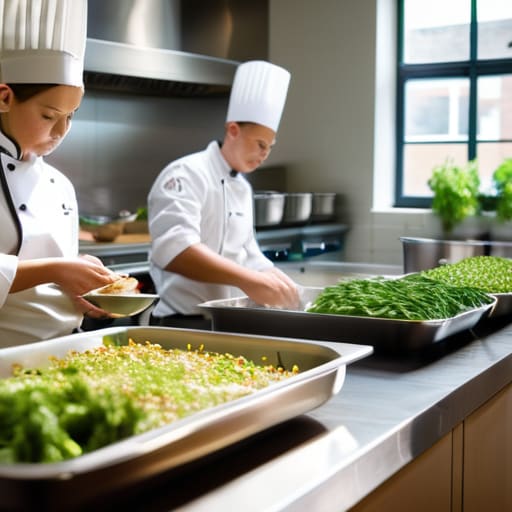
I remember standing in a kitchen in South London three years ago, watching a catering manager stare at a spreadsheet with the kind of hollow-eyed exhaustion you only see when the math simply refuses to work. She had the ingredients, she had the staff, but the bureaucratic labyrinth of how free school meal funding works had left her with a deficit that no amount of “efficiency” could fix. People love to talk about funding as if it’s a simple tap you can turn on, but in a real school kitchen, it’s a complex, often frustrating dance between government allocations, local authority quirks, and the actual, rising cost of a decent head of broccoli.
I’m not here to give you a lecture on policy white papers or the theoretical benefits of nutritional subsidies. I’m going to tell you how to actually navigate the system so you can get the money where it belongs: into the pots and pans. We are going to strip away the administrative fluff and look at the practical reality of managing these funds, focusing on how you can sustain a safe, nutritious service without losing your mind—or your budget—to the fine print.
Table of Contents
Decoding the Government School Meal Grants System

Let’s strip away the jargon for a second. When people talk about the universal free school meals policy, they often make it sound like a simple tap that turns on and off. In reality, the money flows through a complicated web of central government grants and local authority decisions. It isn’t a single, flat cheque sent to every school; it’s a fragmented system where the amount you actually see in your catering budget depends heavily on how your specific local authority interprets the school meal funding allocation formula.
For those of you on the ground, the headache usually starts with the school meal entitlement criteria. You aren’t just managing food; you’re managing a massive administrative hurdle to prove who qualifies for what. If the paperwork for a student’s eligibility is lagging, your budget for the following term might not reflect the actual number of plates you’re putting out. It’s frustrating because while the government discusses high-level subsidies, the people actually buying the milk and the vegetables are the ones left trying to balance the books against a moving target.
The Realities of the School Meal Funding Allocation Formula
Here is the reality: the school meal funding allocation formula isn’t a simple math problem where $X$ amount of money equals $X$ amount of pasta and protein. On paper, the figures look tidy, but once that money hits a school’s bank account, it has to fight for survival against rising energy bills and the sheer cost of quality ingredients. When you are working within the constraints of the universal free school meals policy, you aren’t just managing a budget; you are managing a constant tension between nutritional standards and the reality of what a pound can actually buy in today’s market.
I’ve sat in many kitchen offices where the manager is staring at a spreadsheet, trying to figure out how to meet the school meal entitlement criteria without sacrificing the quality of the produce. It is a delicate balancing act. If the formula doesn’t account for the actual inflation of food costs, you end up with a kitchen staff that is forced to choose between cutting corners on safety protocols or serving meals that don’t actually nourish the children. You cannot fix a systemic funding gap with better cooking techniques, but you can certainly manage the fallout.
Making the Math Work: 5 Ways to Protect Your Kitchen When the Budget Gets Tight
- Stop chasing every penny and start protecting the proteins. When the grant per head is thin, I see kitchens try to cut corners on ingredient quality to make the numbers balance. Don’t. If you lose the nutritional value or the quality of your core ingredients, you lose the kids. If you have to trim, trim the fancy garnishes or the processed sides, not the meat or the legumes that actually keep them full.
- Use the funding for ‘invisible’ safety, not just plates. It’s easy to spend the whole budget on what the kids can see—like more fruit or better packaging—but a chunk of that money needs to be ring-fenced for the boring stuff. I’m talking about high-quality sanitizers, reliable probe thermometers, and proper storage containers. A meal looks great until someone gets sick because you couldn’t afford a decent thermometer.
- Don’t let administrative bloat eat your food budget. I’ve seen schools spend a disproportionate amount of their mental energy—and sometimes actual funds—on complex procurement systems that don’t actually save money. If a new supplier promises a discount but requires three hours of extra paperwork from your lead chef every week, that’s a false economy. Your staff’s time is part of your budget; don’t waste it.
- Prioritize allergen communication over fancy presentation. If you have a limited budget, you might be tempted to use more complex, multi-ingredient recipes to make the meals feel “premium.” Resist this. The more ingredients you juggle, the higher the risk of an allergen error. Stick to cleaner, simpler recipes where you can actually track every single component. It’s cheaper, and it’s infinitely safer.
- Build a “buffer” for seasonal price spikes. The funding is often set in stone, but the supermarket isn’t. If you spend every single penny of your allocation on Monday, you’re going to be in trouble when the price of milk or chicken jumps on Thursday. I always tell managers to aim to spend about 90% of the allocated budget on the core menu, leaving that 10% margin to absorb the inevitable volatility of the food market.
What This Actually Means for Your Kitchen
Don’t let the complexity of the grant formulas trick you into thinking the money is “extra”—it’s a baseline that requires disciplined allocation just to keep the lights on and the food safe.
Prioritize your spending on high-risk essentials, like reliable temperature monitoring and allergen-safe storage, rather than getting distracted by expensive equipment that doesn’t actually reduce your liability.
Understand that while the funding covers the plate, it doesn’t automatically cover the time needed for rigorous safety checks; you have to build that “boring” administrative time into your operational budget from the start.
Frequently Asked Questions
If the funding per child is fixed, how am I supposed to account for the massive price hikes in dairy and meat without cutting portion sizes?
This is exactly where the math stops making sense and the stress starts. If you can’t touch portion sizes—and you shouldn’t, because hungry kids aren’t a safety risk or a nutritional one—you have to look at procurement and waste. Are you buying mid-tier brands when a white-label equivalent meets the same spec? Are you over-prepping? I’ve seen kitchens lose ten percent of their budget simply because they weren’t tracking the exact yield on their protein. Tighten the waste, or the budget breaks.
Does the funding cover the actual cost of allergen-safe ingredients, or am I expected to find that extra money within the standard meal allowance?
Here is the hard truth: the funding doesn’t come with an “allergen premium” attached. You aren’t getting extra pennies just because a child has a severe nut allergy or coeliac disease. You are expected to manage those costs within the standard meal allowance. It’s frustrating, I know. That means you have to be smarter with your procurement—buying versatile, naturally allergen-free staples in bulk rather than relying on expensive, pre-packaged “free-from” substitutes that eat your budget alive.
How much of this budget is actually meant for the food itself versus the administrative overhead and compliance paperwork that eats up my staff's time?
Here’s the hard truth: on paper, the funding is meant for the plate. But in a kitchen serving hundreds, the “overhead” isn’t just office work; it’s the time your staff spends logging temperatures, managing allergen matrices, and proving they aren’t cutting corners. If you’re feeling squeezed, it’s because compliance is an invisible ingredient. You can’t ignore the paperwork without risking the kitchen, but you have to find the balance where the admin doesn’t starve the menu.