
I remember standing in a secondary school kitchen three years ago, the air thick with the smell of burnt gravy and the frantic, rhythmic thud-thud-thud of a prep chef trying to catch up with a service that had already started. The manager was staring at a laminated, twenty-page production schedule that looked like it had been written by a mathematician, not a cook. It was beautiful on paper, but it was utterly useless because it didn’t account for the fact that they only had two working staff that morning. Most textbooks will tell you that learning how to plan production for a service requires complex software or rigid, military-style scheduling, but I’ve seen too many “perfect” plans crumble the second a delivery is late or a staff member calls in sick.
I’m not here to give you a theoretical lecture that ignores the reality of a busy service. Instead, I want to show you how to build a production flow that actually survives the rush. We are going to focus on the critical control points—the few things you absolutely must get right to keep food safe and service moving—so you can stop chasing your tail and start feeling in control.
Table of Contents
Kitchen Workflow Optimization Beyond the Hype
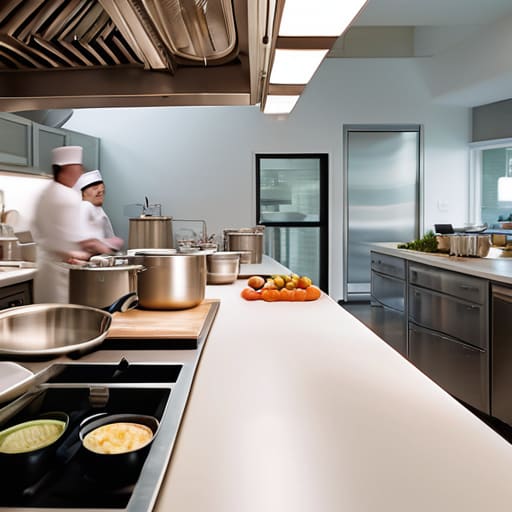
Most consultants will talk to you about “kitchen workflow optimization” as if it’s some high-level mathematical equation involving complex software. In a school kitchen where you’ve got twenty minutes to get two hundred trays of pasta out the door, that’s nonsense. Real efficiency isn’t about fancy apps; it’s about how much distance your staff has to travel between the prep sink and the stove. If your team is constantly crossing paths or searching for a clean whisk during the rush, your system is broken. I’ve seen more service meltdowns caused by a poorly placed cutting board than by a lack of high-tech scheduling.
You need to focus on mise en place preparation that actually respects the reality of your staffing levels. If your prep list is so ambitious that no one has time to actually check the internal temperature of the cooked chicken because they’re too busy chopping onions, you haven’t optimized anything—you’ve just created a hazard. Stop trying to implement a twenty-step process. Instead, look at your standard operating procedures for service and strip them down to the essentials that prevent errors when the heat is on.
Service Capacity Management and the Reality of Fatigue
I’ve sat in too many staff rooms at 11:00 AM, watching a team that looks like they’ve already run a marathon before the first lunch bell has even rung. We talk a lot about service capacity management in theory, but in a school kitchen, capacity isn’t just about how many ovens you have; it’s about the cognitive load on your staff. When people are exhausted, they stop checking labels. They stop verifying temperatures. They start taking shortcuts that look like efficiency but are actually just cracks in your safety net.
If you try to push a skeleton crew to meet a peak period demand forecasting model that assumes everyone is operating at 100% mental clarity, you are setting yourself up for a failure. You cannot plan production for a service based on a “best-case scenario” where everything goes right. Real food service operational efficiency comes from building in a buffer for the inevitable: the broken dishwasher, the late delivery, or the person who calls in sick. Don’t aim for a kitchen that runs like a Swiss watch; aim for one that doesn’t collapse when a single gear slips.
The Three Critical Controls: What to Prioritize When the Rush Hits
- Stop trying to prep everything at once. Pick your three highest-risk items—the ones that are most likely to be served at the wrong temperature or with an unrecorded allergen—and build your entire production schedule around ensuring those three are bulletproof.
- Build your prep lists around your staff, not your recipes. If you have one person who is brilliant with a knife but struggles with paperwork, don’t put them in charge of the allergen labeling; put them on the veg, and keep your most meticulous person on the prep-and-label station.
- Use “buffer time” as a physical space in your schedule. If you think a batch of sauce takes twenty minutes, plan for thirty. That ten-minute gap isn’t wasted time; it’s the only thing that will prevent a temperature spike or a cross-contamination error when the delivery driver shows up late.
- Stop the “just one more thing” habit. In a school kitchen, the temptation to squeeze in one extra task during a lull is high, but if that task compromises your cleaning sequence or your temperature logging, it’s not a win—it’s a debt you’ll be paying back during service when things go wrong.
- If it isn’t written down, it didn’t happen, but don’t make the paperwork a chore. Create “checkpoint” moments in your production plan—specific times, like 10:30 AM, where the only job is to check the fridge logs and the prep labels—so it becomes a habit rather than a frantic scramble at the end of the shift.
The Bottom Line: What Actually Matters When the Rush Hits
Forget the complex spreadsheets; focus on your critical control points. If you can’t maintain temperature logs and allergen separation during a peak service, your entire production plan has failed, no matter how “efficient” the prep was.
Build your plan around your weakest link, not your best chef. A production schedule is only as good as the person who has to execute it at 11:30 AM when they’re tired and the orders are piling up.
Prioritise sustainable discipline over perfection. I would much rather see a kitchen that consistently hits its core safety and prep targets than one that attempts a massive, over-ambitious system and abandons it halfway through the week.
Frequently Asked Questions
I know my staff are exhausted, but how do I decide which prep tasks are non-negotiable and which ones we can actually push to the next shift without risking a safety breach?
Look, I’ve seen the fatigue. When the team is running on fumes, you stop trying to do everything and start protecting the critical points. Non-negotiables are anything involving high-risk allergens, temperature-sensitive prep, and cross-contamination barriers. If it’s just chopping garnish or prepping a sauce that can wait until tomorrow’s prep window without compromising safety, push it. Don’t let “getting it all done” lead to a shortcut that ends up in a hospital.
If we’re running a skeleton crew on a Tuesday, what’s the absolute minimum amount of production planning I need to do to stop the kitchen from descending into chaos?
When you’re down to a skeleton crew, forget the fancy spreadsheets. You need three things: a definitive “must-make” list, a clear prep-to-service timeline, and a hard stop on anything non-essential. If a prep task doesn’t directly prevent a service delay or a safety risk, scrap it. Don’t try to run a full menu on a Tuesday crew; pick your battles, protect your critical control points, and focus on what’s actually hitting the plates.
How do I balance the need for strict, time-stamped production logs with the reality that my team barely has time to breathe, let alone write?
Stop trying to turn your staff into data entry clerks. If they’re too busy to write, your logging system is broken, not your team. Ditch the long-form narratives. Move to a “tick-and-sign” system or use a simple digital tablet where a single tap records a temperature. If a task takes more than ten seconds to document, it’s a luxury you can’t afford mid-service. Focus on the critical timestamps—the ones that actually prove food safety—and let the rest go.