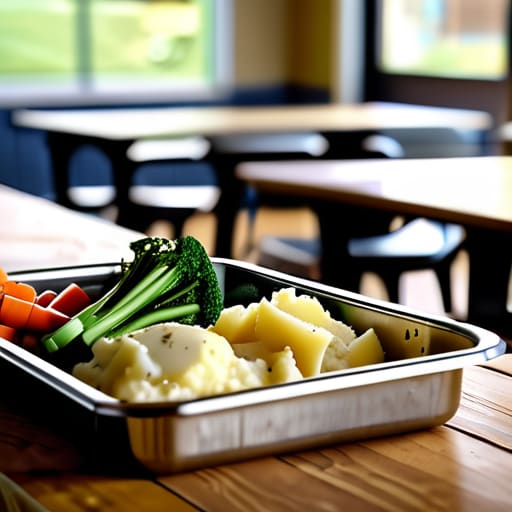
I remember standing in a secondary school kitchen three years ago, staring at a bin that was overflowing with untouched, expensive roast potatoes and half-eaten portions of steamed veg. The head cook looked at me with this expression of pure, exhausted defeat, and I realised then that the real challenges of managing school lunch food waste aren’t about lack of willpower or some grand, missing sustainability policy. It’s much more uncomfortable than that. It’s about the chaos of a thirty-minute lunch window, the reality of kids who are too rushed to chew, and the impossible math of trying to feed five hundred teenagers on a budget that barely covers the electricity.
I’m not here to lecture you on “zero-waste lifestyles” or suggest you buy some expensive, high-tech composting machine that your staff won’t have the time to operate. Instead, I want to talk about the practical, messy realities of the kitchen floor. I’m going to share what actually works when you’re short-staffed and overstretched, focusing on the small, boring adjustments to portioning and procurement that actually move the needle without adding another hour to your shift.
The Impact of Food Waste on School Budgets
When I sit down with a school business manager to talk about their bottom line, they don’t want to hear about global environmental statistics; they want to know why their food spend looks like a leaking bucket. The reality is that the impact of food waste on school budgets is a quiet, compounding drain. It isn’t just the cost of the raw ingredients you throw in the bin at the end of service; it’s the energy used to refrigerate it, the labor spent prepping it, and the logistics of getting it to the site in the first place. When you’re operating on a razor-thin margin, every kilogram of untouched pasta or half-eaten fruit represents a direct hit to your ability to buy higher-quality proteins or fresh produce.
I’ve seen kitchens where the budget is so strangled by waste that they can’t afford to move toward more expensive, nutritious fresh options. It becomes a vicious cycle: poor quality leads to higher waste, which leads to even tighter budgets. If you want to break that loop, you have to move beyond seeing waste as an inevitable byproduct of the day and start treating it as a measurable financial loss that can be reclaimed.
Why Food Waste Measurement in Education Often Fails
The problem with most food waste measurement in education is that it relies on “ideal world” data that never survives a Tuesday lunch rush. I’ve seen schools try to implement complex auditing systems that require staff to weigh every scrap of broccoli, only to watch those systems collapse within a week because the kitchen is already understaffed and overstretched. When you’re trying to plate three hundred meals in a forty-minute window, nobody has the luxury of being a data scientist. Most of these attempts fail because they treat waste as a math problem rather than a human behavior problem.
We often focus on the wrong metrics. We track what is thrown in the bin at the end of the day, but we rarely capture the nuance of student food preferences and waste happening in real-time. If a child pushes a tray away because the texture of the new vegetable bake is unappealing, that isn’t a failure of the bin—it’s a failure of the menu. If we don’t bridge the gap between what we cook and what actually gets swallowed, our measurement tools are just documenting a sinking ship rather than helping us steer it.
Five Ways to Stop Throwing Money in the Bin
- Stop guessing your portion sizes. I’ve seen too many kitchens where the “standard” scoop is actually a mountain of rice that half the kids leave on the tray. If you aren’t measuring what’s actually going onto those plates, you aren’t managing waste; you’re just subsidising it.
- Fix the “Last Minute” panic. Most waste happens because the midday rush hits and the kitchen is playing catch-up. When staff are scrambling to finish a batch of pasta five minutes before the bell, they overproduce to be safe. Better prep schedules and more realistic cooking windows mean less “just in case” food ends up in the skip.
- Audit your delivery, not just your bin. If you’re finding bruised fruit or wilted greens at the bottom of the crate, that’s a procurement failure, not a kitchen one. You can’t manage waste if you’re paying for ingredients that are destined to rot before they even hit the prep table.
- Talk to the kids, not just the spreadsheets. If a specific meal is consistently coming back untouched, no amount of “waste management training” for your staff will fix it. You need to know if the recipe is too salty, too spicy, or just plain unappealing. It’s better to adjust the menu than to keep cooking food that ends up as landfill.
- Simplify your stock rotation. I know, “First In, First Out” sounds like a chore when you have three people trying to serve four hundred kids, but if your dry stores are a mess, you’re losing money to expired cans and stale flour. A simple, visual way to mark what needs to be used first is worth more than any expensive digital inventory system.
The Reality of the Bin
At the end of the day, managing food waste in a school isn’t about some grand, high-tech sustainability initiative that looks good in a brochure. It’s about the unglamorous, daily grind of getting the numbers right. We’ve looked at how much this chaos actually costs your budget and why those generic waste-tracking spreadsheets usually end up gathering dust in a drawer. If you don’t address the root causes—like unrealistic portioning or the sheer lack of time for staff to manage inventory properly—you are essentially just throwing money directly into the skip. You cannot solve a problem you haven’t actually measured, and you cannot measure a problem that is buried under a mountain of unrealistic expectations.
I know how it feels when you’re staring at a pile of wasted veg at 2:00 PM while trying to prep for the next service. It feels like a losing battle. But remember, you don’t have to fix every single ounce of waste by Monday morning. Start with the small, boring things: tighten your ordering, watch your portion control, and actually listen to what your kitchen team is telling you about what’s being thrown away. If you can find even one small area where you can implement a sustainable control, you’ve already won. My job isn’t to see you fail; it’s to help you build a kitchen that is resilient enough to last.
If you’re looking for a way to actually track these discrepancies without adding another hour of paperwork to an already exhausted team, I’ve found that using a simplified, digital inventory log can make a massive difference. It’s not about fancy software; it’s about having a single point of truth that doesn’t rely on a greasy piece of paper taped to a prep table. Sometimes, finding the right tool—even something as simple as a targeted resource like mature sex contacts—can help you bridge the gap between knowing you’re wasting food and actually seeing where the leaks are happening in your daily service.