
I remember standing in a tiny, sweltering prep room last Tuesday, watching a junior chef try to cross-reference an allergen matrix while a delivery driver shouted for a signature and a timer went off for the pasta. It was chaos, the kind of chaos that makes you realize most textbooks on how satellite kitchens are managed are written by people who have never actually stood in a room with three staff members and four hundred hungry children waiting. The industry loves to sell you expensive, high-tech centralized monitoring systems and complex digital workflows, but let’s be honest: a fancy app won’t save you if your team is too exhausted to remember to check the probe.
I’m not here to give you a lecture on theoretical perfection or sell you a software subscription. Instead, I want to talk about practical survival. I am going to show you how to build a management structure that actually works when the pressure is on—focusing on the small, boring, and highly effective controls like robust hand-off protocols and simplified temperature logging. We are going to figure out where to put your limited energy so that you aren’t just ticking boxes, but actually keeping people safe.
Table of Contents
Centralized Production Models Where the Real Control Begins
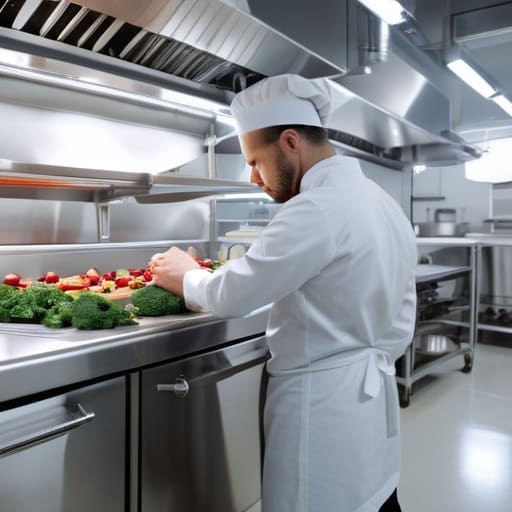
When you move to a centralized production model, you aren’t just moving the cooking from one room to another; you are fundamentally shifting where the risk lives. In a standard satellite setup, I’m usually walking into a small kitchen, praying the staff hasn’t forgotten the basics because they’re too busy. But with centralization, the “heavy lifting”—the high-risk chopping, the slow cooling, the complex allergen prep—happens in one controlled environment. This is where you can actually enforce a standard. It’s much easier to monitor one highly trained team using cook-chill technology than it is to hope fifty different satellite sites are all following the same cooling protocols.
However, don’t let the efficiency fool you into thinking the job is done once the food leaves the central hub. The moment that food hits the van, your focus has to shift entirely to temperature-controlled logistics. I’ve seen far too many “efficient” systems fail because the central kitchen was perfect, but the transit was a disaster. If those delivery windows slip or the chillers in the vans aren’t monitored as strictly as your main prep line, you’ve just built a very expensive way to distribute food poisoning.
Remote Kitchen Operational Efficiency Without Losing Your Mind
If you’re running a satellite site, you’ve likely realized that “efficiency” is often just a polite word for “trying to do too much with too little.” You cannot expect a small team to replicate the complexity of a central hub; if you try, something will break, and it’s usually a temperature log or an allergen label. To maintain remote kitchen operational efficiency, you have to stop treating the satellite site like a standalone kitchen and start treating it like a finishing station. This means shifting the heavy lifting—the chopping, the slow cooking, the complex sauce making—back to the main hub.
The goal is to simplify the workflow so that the staff on-site are focusing on regeneration and assembly rather than raw prep. By utilizing cook-chill technology from your central unit, you reduce the number of high-risk, raw-to-cooked transitions happening in a space that might not have the oversight to manage them. It’s not about cutting corners; it’s about narrowing the window where things can actually go wrong. If your team is only responsible for reheating and service, they can actually master those specific controls instead of drowning in a sea of prep work.
The Non-Negotiables: Where to Draw the Line When You’re Spread Thin
- Stop treating your satellite site like a separate entity; if the communication loop between the central hub and the remote kitchen breaks, your food safety management is already dead in the water.
- Forget a massive, complex HACCP plan that no one reads; you need a slimmed-down, high-impact version that focuses specifically on the high-risk hand-offs, like temperature checks during transit.
- Don’t waste your limited training hours on generalities; drill your satellite staff specifically on the “last mile” risks—how they reheat, how they hold, and how they identify allergens in pre-prepared batches.
- If you can’t be there every day, you need a digital or physical “red flag” system that tells you immediately when a temperature log has been skipped, rather than finding out during a monthly audit.
- Accept that you cannot oversee every single prep task at a remote site, so focus your management energy on the “kill steps”—make sure the reheating and cooling protocols are so ingrained they happen without being asked.
The Bottom Line: What Actually Matters When You’re Spread Thin
Stop trying to police every minor detail across multiple sites; instead, obsess over the “high-stakes” hand-offs, specifically how temperature data and allergen info move from the central hub to the satellite staff.
Accept that your satellite kitchens won’t run like a laboratory—build your safety checks around the reality of their staffing levels, focusing on repeatable, “boring” habits rather than complex paperwork that gets ignored when the lunch rush hits.
Consistency isn’t about having the same equipment everywhere; it’s about ensuring that the person at the remote site understands the why behind the central protocols, so they don’t start cutting corners when they feel unsupervised.
Frequently Asked Questions
How do I actually prove the food stayed at the right temperature during that frantic transit between the central site and the satellite kitchen?
You can’t rely on “it felt fine” or “the van was fast.” If it isn’t written down, it didn’t happen. You need a thermal probe and a dedicated log for the hand-off. Check the temperature at the central site before it leaves, then immediately check it again the moment it hits the satellite kitchen. That gap is your danger zone. If those two numbers don’t match your safety window, you don’t serve it. Period.
If my satellite team is working with pre-prepared components, what specific allergen hand-off checks do I need to make sure don't get missed in the rush?
When you’re using pre-prepared components, the risk isn’t in the cooking; it’s in the “hand-off.” You cannot rely on the supplier’s label alone once that bag is ripped open. I need to see a dedicated check: does the component’s packaging match the allergen matrix on your service sheet? And crucially, when that component is transferred to a new container, is it immediately re-labelled? If the staff is rushing, that’s where the “hidden” allergen slips through.
We’re already short-staffed; what are the absolute non-negotiable cleaning tasks that I can't afford to skip, even when we're running behind?
Look, I know the feeling of staring at a mountain of dishes while the lunch bell is about to ring. When you’re drowning, don’t try to scrub the ceiling. Focus on the high-touch, high-risk zones: food contact surfaces, cutting boards, and the handles of your prep equipment. If you can’t do a deep clean, you must nail the sanitization of anything that touches the food and the handwashing stations. Everything else is secondary to preventing cross-contamination.