
I’ve sat in far too many budget meetings where people talk about “how catering supports the wider curriculum” as if it’s some magical, expensive alchemy that requires a complete overhaul of the school’s mission statement. They suggest we need high-end sensory workshops or elaborate garden-to-plate schemes that simply don’t work when you have three staff members trying to get four hundred lunches out the door by 12:15. To me, that’s just more fluff that ignores the reality of a working kitchen. If we want to actually support learning, we need to stop looking for the grand, expensive gestures and start looking at the operational discipline already happening right under our noses.
I’m not here to sell you on a fairytale or a list of impossible ideals. My promise to you is much more grounded: I’m going to show you how to take the unseen, everyday routines—from the way we manage allergens to the science of temperature control—and turn them into practical, real-world touchpoints for students. I’ll give you the honest, no-nonsense truth about what is actually sustainable in a high-pressure environment, and how you can make those small, boring, essential tasks work for your students without breaking your team.
Table of Contents
Vocational Training in Hospitality Beyond the Kitchen Door
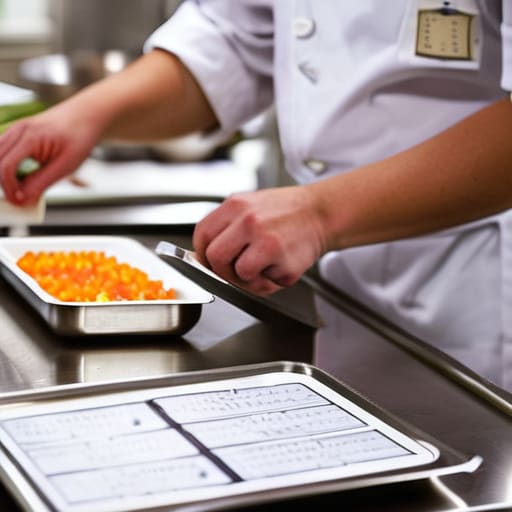
We often make the mistake of thinking vocational training in hospitality ends at the service hatch. If we treat the kitchen as a closed loop—just a place where food is produced and disappeared—we miss a massive opportunity for student engagement. When students see the catering team managing inventory, calculating costings, or even navigating the complexities of allergen labeling, they aren’t just looking at “lunch being made.” They are witnessing applied mathematics and logistical management in real-time.
I’ve seen much more impact when we bridge that gap by bringing students into the fold. Instead of keeping the kitchen staff in a separate silo, we should be using these spaces for experiential learning in catering. Imagine a student seeing how a recipe is scaled up from four portions to four hundred, or how a single error in a delivery note can derail a whole week’s menu. That isn’t just “cooking”; it’s a lesson in precision and consequence. If we can move past the idea that the kitchen is just a utility room, we can turn it into a living laboratory for practical life skills that actually stick.
Cross Curricular Learning Opportunities That Actually Stick
We need to stop viewing the kitchen as a siloed space that only exists to feed hungry kids. If we want to see real cross-curricular learning opportunities, we have to look at the math and science happening on the prep tables. When a student is calculating the scaling of a recipe for a hundred covers, or monitoring the precise temperature of a cooling bath to prevent bacterial growth, they aren’t just following a manual; they are performing applied mathematics and microbiology. It’s one thing to read about thermal death points in a textbook, but it’s quite another to see why that temperature matters when you’re holding a tray of chicken.
This is where food technology and nutrition education move from theory into something tangible. I’ve seen much more engagement when a student understands the chemical reaction of leavening agents or the way acidity affects food preservation through a hands-on lens. It shouldn’t feel like an extra chore for the teachers, either. Instead of forcing a connection, we should be leveraging the existing kitchen routines—the inventory checks, the nutrient profiling, even the waste management—as live demonstrations of the curriculum in action.
Five Ways to Turn Your Kitchen Routine into a Classroom Resource
- Stop hiding the food safety logs; use them as live data for maths lessons. Instead of just checking that the fridge is at 5°C, have students plot the temperature fluctuations over a week. It turns a “boring” compliance task into a practical lesson on averages, trends, and the real-world consequences of a broken seal.
- Use your allergen management as a biology and chemistry bridge. When you’re prepping for a child with a severe nut allergy, don’t just treat it as a “keep out” zone. Use it to explain how proteins trigger immune responses or how cross-contamination works at a molecular level. It makes the “why” behind the rules much more visceral than a poster on a wall.
- Turn the procurement process into a sustainability and geography seminar. When you’re choosing between a cheap bulk supplier and a local farm, don’t just make the decision in a vacuum. Show the students the cost-benefit analysis and the carbon footprint of the delivery routes. That’s where the “theory” of environmental impact meets the reality of a school budget.
- Make the kitchen a laboratory for nutritional science. Move beyond the “eat your greens” lecture and use your actual weekly menu to teach macro and micronutrients. If you’re serving a high-protein meal, show them the ingredients that got you there. It’s much harder for a student to ignore nutritional value when they can see the raw ingredients on the prep table.
- Treat your cleaning schedules as a lesson in systematic logic. A kitchen isn’t cleaned by “wiping things down”; it’s cleaned through a sequence to prevent re-contamination. Teaching students the logic of a top-to-bottom, clean-to-dirty workflow builds a sense of operational discipline that applies to science labs, workshops, and just about any organized environment.
The Bottom Line: Making it Work Without Adding More Paperwork
Stop treating the kitchen as an island; when you bridge the gap between food prep and the classroom, you aren’t just teaching nutrition, you’re teaching real-world accountability.
Focus on the “boring” stuff—like allergen control and temperature logs—as the primary teaching tools for discipline and procedural accuracy.
Don’t try to overhaul everything at once; pick one practical routine that already exists in your kitchen and find a way to link it to a lesson plan.
Frequently Asked Questions
How do I actually find the time to involve students in these processes without compromising my food safety protocols or falling behind on service?
You don’t find the time; you bake it into the existing workflow. If you try to schedule “learning sessions” during a lunch rush, you’ll fail, and your food safety will suffer. Instead, use the moments that are already happening. Have a student shadow the temperature log check during the morning prep, or let them observe the allergen verification process when a new delivery arrives. It’s about integration, not addition. Keep it small, keep it supervised, and keep it part of the routine.
What's the best way to involve students in something like allergen management without creating a massive liability risk for the school?
Don’t let them touch the actual allergen-controlled prep—that’s a non-negotiable boundary. Instead, use them for the “detective work.” Have them audit the delivery notes against the ingredient labels or practice cross-referencing a recipe card with a dummy allergen matrix. It teaches them the gravity of the documentation without them actually holding the knife. You want them learning the discipline of the check, not the risk of the mistake.
If I want to use my kitchen as a "living classroom," how do I keep the learning practical so it doesn't just feel like more theoretical paperwork for the kids?
Stop treating the “learning” part like a lecture and start treating it like a shift. If you want it to stick, don’t hand them a worksheet; hand them a probe and a temperature log. Let them own a specific, high-stakes task—like verifying the core temperature of a chicken thigh or managing the allergen sweep for a midday service. When the stakes are real and the task is practical, the theory stops being “paperwork” and starts being survival.