I’ve stood in enough school kitchens during a Friday lunch rush to know that a shiny, expensive “safety training seminar” won’t do a damn thing when a junior chef is rushing to clear a spilled pot of gravy. I’ve seen managers pour money into high-tech floor coatings while ignoring the fact that their staff are too exhausted to even grab a mop. Most of the official guidance on how slips, trips and falls are prevented is written by people who have never actually stood on a greasy floor at 11:30 AM while trying to serve four hundred hungry kids. It’s all nonsense—too much theory and not enough reality.
I’m not here to give you a lecture or a checklist that you’ll just tuck into a drawer to satisfy an auditor. I want to talk about the small, slightly annoying habits that actually keep your team on their feet when the pressure is on. I’m going to show you what is actually sustainable in a high-pressure environment, focusing on the practical controls that work when you’re short-staffed and slammed. We’re going to look at real-world solutions, not textbook fantasies.
Table of Contents
Why Hazard Identification and Mitigation Fails Under Pressure
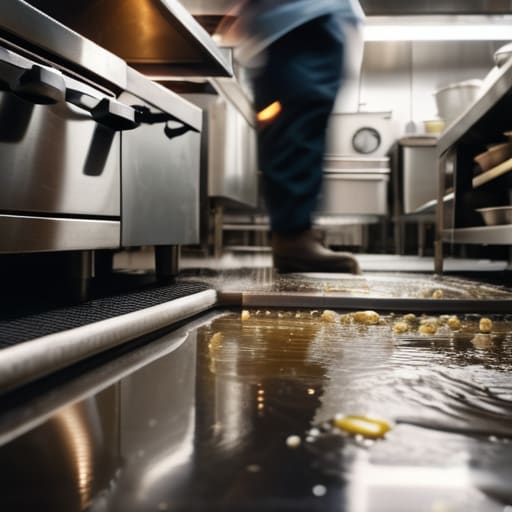
The problem isn’t that kitchen staff don’t know a wet floor is dangerous; it’s that they are operating in a state of constant, high-speed triage. When you’ve got a delivery driver waiting at the bay, a sauce that’s just gone split, and a lunch service starting in ten minutes, your brain naturally prioritises the immediate crisis over hazard identification and mitigation. You see a splash of oil near the fryer and your internal monologue says, “I’ll get that in a minute,” but that minute is when the accident happens.
Under pressure, even the most robust workplace safety protocols tend to feel like an extra weight rather than a safety net. I’ve stood in kitchens where the staff are brilliant, but they are so focused on the “doing”—the cooking, the plating, the serving—that they stop “seeing” the environment. They stop noticing the slight buildup of grease on a tile or the way a floor mat has curled at the edge. It isn’t negligence; it’s cognitive overload. When you’re sprinting to keep up with a school lunch schedule, the small details become invisible.
The Small Boring Habits of Effective Workplace Safety Protocols
Realistically, you aren’t going to reinvent the wheel every Monday morning. Effective workplace safety protocols aren’t about fancy new technology; they are about the stuff that feels tedious when you have fifty lunch trays to prep and a broken dishwasher. It’s the decision to actually use the mop immediately after a spill rather than telling yourself you’ll get to it during the lull. That lull rarely comes. If your team treats floor maintenance best practices like a chore to be deferred, you’re essentially just waiting for someone to go down.
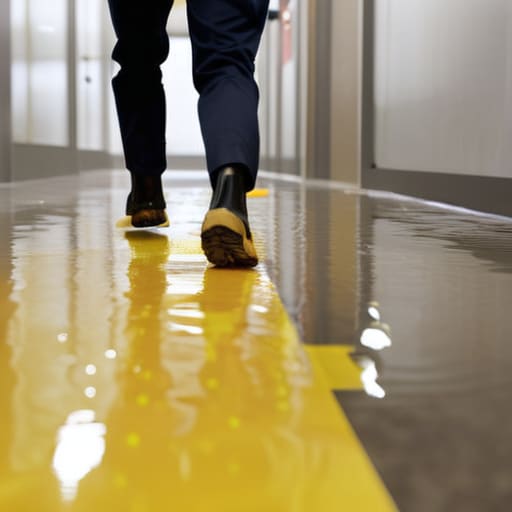
The most successful kitchens I’ve inspected don’t necessarily have the most expensive equipment; they have the most consistent habits. It’s about the “boring” stuff: ensuring non-slip mats are actually laid flat and not curled at the edges, or making sure the cleaning schedule follows a logical sequence so you aren’t walking over wet tiles to reach the dry ones. You don’t need a massive budget to start preventing workplace accidents; you just need a team that agrees that a quick “watch out” or a well-placed yellow sign is more important than shaving thirty seconds off a task.
Five Things That Actually Work (When the Lunch Rush Hits)
- Stop treating “wet floor” signs like optional decor. If you spill something—oil, water, even just a bit of sauce—the sign goes down immediately. I don’t care if you’re mid-prep; a sign takes two seconds, but a broken wrist takes six months of rehab.
- Get your footwear sorted properly. I’ve seen staff trying to get by in trainers because they’re “more comfortable” during a long shift, but if they don’t have that specific slip-resistant grip, you’re basically walking on ice. It’s an investment in your own bones, not just a uniform rule.
- The “Clean as You Go” rule isn’t just some management cliché to make you work harder; it’s about clearing the path. If you leave a crate in the middle of the walkway or a trail of flour behind you, you are setting a trap for the person coming around the corner behind you.
- Fix the mats, don’t just buy them. I can tell within ten seconds of walking into a kitchen if the anti-fatigue mats are curled at the edges or tripping people up. If a mat is a hazard, it’s not a safety tool anymore—it’s just a very expensive obstacle. Get it replaced or move it.
- Communication needs to be louder than the extractor fan. If you’re mopping a floor or if there’s a leak under the prep sink, shout it out. “Floor’s wet by the prep station!” isn’t being annoying; it’s making sure the person carrying a heavy pot of boiling pasta doesn’t go flying.
What I Want You to Take Away from This
Stop waiting for a “safety meeting” to fix things; real prevention happens in the three seconds between dropping a spoon and grabbing a cloth.
If your safety protocols require a staff member to stop everything for ten minutes to fill out a form, they won’t do it—so design your systems to be quick, visible, and actually doable when the lunch rush hits.
You don’t need a perfect kitchen, but you do need a predictable one; focus on the high-traffic, high-risk zones first rather than trying to tidy up every corner at once.
Frequently Asked Questions
How do I balance the need for immediate cleaning with the reality of a service rush where I can't just abandon the pass?
You don’t abandon the pass, but you don’t ignore the spill either. That’s how people end up in A&E. If you can’t mop it right that second, you “triage” it: throw a damp paper towel over it or, better yet, put a physical barrier—a chair, a crate, a yellow sign—right in the path. It’s about marking the danger so the next person doesn’t walk blindly into it while you’re plating up.
If my staff are already wearing non-slip shoes, what else can I actually do to stop a fall when the floor is inevitably wet?
Non-slip shoes are a great start, but they aren’t magic. You can have the best grip in the world, but if there’s a literal lake of oil or soapy water on the floor, physics is going to win every time. Focus on the “wet” part. If you can’t mop it up instantly, you need a physical barrier—a sign, a cone, or a staff member directing traffic. Control the environment, don’t just rely on the footwear.
How do I get my team to actually care about reporting a near-miss instead of just seeing it as more paperwork at the end of a long shift?
Stop calling them “near-miss reports” and start calling them “saves.” If a staff member tells me they almost slipped on a patch of grease, I don’t hand them a clipboard; I thank them for stopping a broken hip. If they see a report results in a new non-slip mat or a better drainage fix, they’ll write them. If they report it and nothing changes, they’ll never bother again. Show them the paperwork actually fixes the kitchen.